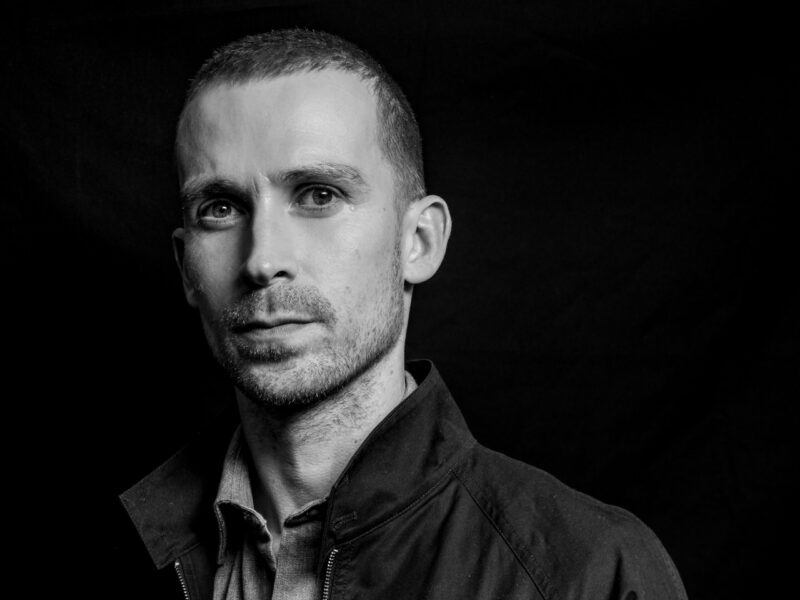
Thom Oosterhof: „Our body becomes a sort of tapestry of experience, physical, mental and emotional. Personal and shared”
IOMO Gallery hosts the exhibition In the Body Lies the Truth, curated by Thom Oosterhof. Based in Amsterdam and voted a „Curator to Watch in 2024” by FollowArt, Oosterhof has coordinated international projects and is recognized for championing the next generation of artists across global markets. We spoke with him about the curatorial vision behind this project, the selection of the nine international artists, and how the raw detail of the body becomes a universal language.
CLICK HERE FOR THE ROMANIAN VERSION
The exhibition is built on the premise that „the truth lies in the body” In an era of AI and digitally manipulated imagery, how do you see the role of painting and physical form in preserving this „untouches” truth?
The first thing to acknowledge is that the very art of painting is false. Painting a still image can never be ‘true’, thus the exhibition holds this contradiction at its heart. But it is through acknowledging this that we can open the space to appreciating its attempt to get as close to the truth as possible. Through human touch and conscious effort, the artist invests in the medium, nothing comes for free. So to recognize that often telling the truth is harder than a lie is important to remember.
Brancusi said that what is real is the essence of things. In your selection for IOMO, the artists seem to update this notion of essence: they don’t seek the truth through simplification, but through the power of raw detail. Were you specifically looking for artists who transform the particular – a vein, a texture, or a glance – into a universal language of the body?
Exactly! You notice that all of these artists carry this emotional charge within their depictions of the body. What was important was how each differed rather than their similarities. Even through the act of cropping, which you see a lot in the show, is an instant distillation of a moment, of an image, of a feeling. If an artist can charge a work with as much, if not more, feeling than that of a complete image, they are really onto something. I hoped to bring together great examples of just that, and I’m pretty thrilled with the outcome!
Beyond the obvious presence of figurative art, what was your „invisible” criterion in choosing these nine artists? Were you looking for a specific vulnerability in the brushstroke, or perhaps a capacity to capture the body outside of its social „performance”?
I love that word vulnerability. All of the artists in this exhibition are vulnerable in their own way, on different scales. Simply the act of creating and presenting as an artist already creates a degree of vulnerability. Will they like it? Will it sell? Will it hold up next to the other artists? The funny thing is that this vulnerability never goes away for an artist – it is often what drives them. But you are right, I wanted to bring together moments that seemed outside of the ‘social performance’, moments of quiet, of ‘resting faces’, where figures are almost caught unaware that they are being observed. This combination runs as a central thread through the show.
You made a fascinating parallel between the body and the Romanian „ia”;, which you call „a manual of the body”. What specifically about the geometry or the history of this traditional garment helped you define the exhibition’s concept for the Bucharest audience?
What I loved about the idea of the ‘ia’ is its cultural heritage and its ability to travel generations. What we forget about the body is that it is not distinctly our own. It is a combination of our parents, their parents, their parents and so on. All most as if our bodies are passed down generations. Full of generational ‘traumas’, memories, stories, ways of being in this world, and everything in between. Much like the ‘ia’ is threaded with cotton and other fabrics, our body becomes a sort of tapestry of experience, physical, mental and emotional. Personal and shared. I loved that similarity.
In a world that forces us to be an edited, „polished” version of ourselves, do you see this exhibition as an act of rebellion, or as a necessary return to what actually makes us fragile and real?
I do love a little resistance and try where I can to poke the bear a little. It is really a response to us moving away from ourselves physically, towards the digital, emotionally, towards medication, and spirituality, towards something altogether different. By returning the truths inherent in our flesh I hope to remind people of the raw beauty that exists within love, pain and everything in between.
This exhibition functions as an interrogation of our physical presence. What kind of „trace” do you hope these works leave in the viewer’s mind? Do you want them to feel a sense of comfort or, on the contrary, a certain unease regarding their own body?
Both ideally! There are beautiful moments of affection coupled with moments of hope, dread, despair, joy and love. Some may find solace in the solemn, others happiness among the happy. I wanted to leave all of these doors open for the viewer. What I hope most of all is that something is remembered, a week from now, a month, or ambitiously, a year from now. That is the power of art and the image, one truly experienced that is.
IOMO Gallery has quickly established itself as a space that isn’t afraid of strong aesthetics. How did you find the energy here, and how does the gallery’s vision align with the standards and the boldness you encounter in the major art capitals where you work?
The team at IOMO are brave and ambitious. Just what the art world needs more of. They are always stretching the boundaries of where they are comfortable and what they know, striving to create something original, lasting and one that contributes. I hope that by introducing an international scene, alongside their strong local programme, that patrons of the gallery have their own horizons broadened. Resting in the knowing that Romanian art can hold it’s own on the international stage, both in terms of its budding artists and the galleries in which they are championed.